

Shortly after my memorable, albeit embarrassing, interview day, I received a call from the interviewer who had called me in the stairwell and conducted my final interview. From this point forward, although I won’t disclose her real name, we’ll call her Gladys. Gladys was calling to offer me a job on the Model Development team. I would be reporting to her, but members of the Model Development team would be managing my day-to-day work. I accepted the offer and was anxious to start a few weeks later.
On my first day, I headed downtown to meet the team, settle in at my desk (successfully having used the elevator), and get started with any orientation activities. Upon arrival, I met the team of about eight other individuals. I ate my lunch and got started with some housekeeping activities. The following day, one of the members of the team began to train me and provide me with assignments. The learning curve felt steep.
For the next several weeks, my days went as follows: take the train downtown sleeping on the way down, get to work, log-in to check my low volume email inbox, try to write and debug some code I was working on until I could meet with someone on the team, and read from the materials they had provided me. On this team, you could hear a pin drop throughout the day in the office as everyone focused on the code and statistics in front of them. Each day, I quietly sat at my desk, minding my own business until I met with the team member working with me and would leave for the train at 4:45 pm. It was a bland life but not terrible; I figured that this was a typical corporate experience and that would be the next 40 years of my life. I had no prior exposure to benchmark off of.
One day, Gladys came to the downtown office, and having just finished her MBA, I figured it might be a good idea to ask her about which school programs I should be looking into to earn a Masters degree. Members of the Model Development team had been encouraging me to go back to school; so, as she was walking down the hallway, I asked her if she would have time to chat about this. Although I was intimidated and a little put off by Gladys from my early encounters with her, I figured that she would still be a good resource to consult. She spoke to me for a long time about her experience and ultimately recommended that I should figure out what career path I really want to focus on and gain more experience before pursuing a Masters program. The insight and recommendation was much appreciated and a major relief to hear. What I didn’t know at the time of this simple conversation was:
1) Gladys always had a packed calendar and a high list of demands. This proves two points. The first being that it never hurts to ask for a conversation, no matter how busy or how high ranking the person is. The worst that can happen is someone says no, and in most cases, people love to be able to share their knowledge and experience to help others. The second point is really just a credit to Gladys and the fact that strong leadership will invest the time in their team.
2) This would be one of the early turning points in my career. By having the courage to ask Gladys for the conversation and keeping an open mind, I began to change my opinion about Gladys and began to look up to her. Gladys also had the opportunity to engage with me rather than seeing me sit quietly coding at my desk.
3) Lastly, I didn’t know that Gladys would soon become a mentor and sponsor to me. After that, she would also become a close friend. To this day, she still serves all those roles for me and despite my rocky start, I’m incredibly grateful for her role in my life.
Anyways… a few weeks later, Gladys called me into her office and began to ask how things were going on the Model Development team and if I was enjoying what I was doing. This was somewhat tricky business to navigate. I wasn’t really either loving or hating what I was doing, I was fairly new and didn’t want to rock the boat, but I also was beginning to warm up to Gladys. I tried to take a middle ground approach to be tactful and respectful of the team but also not make it seem like I thought I was destined to be a model developer for life. Her line of questioning then made sense because she asked if I wanted to serve as a project manager for an annual stress test exercise that the bank had to go through. I told her I didn’t know what that meant but that I was always willing to try anything. Even more lessons came out of this conversation:
1) It is beneficial to be tactfully and respectfully honest about how you are feeling in a situation. The situation can’t change unless you voice your feelings on it.
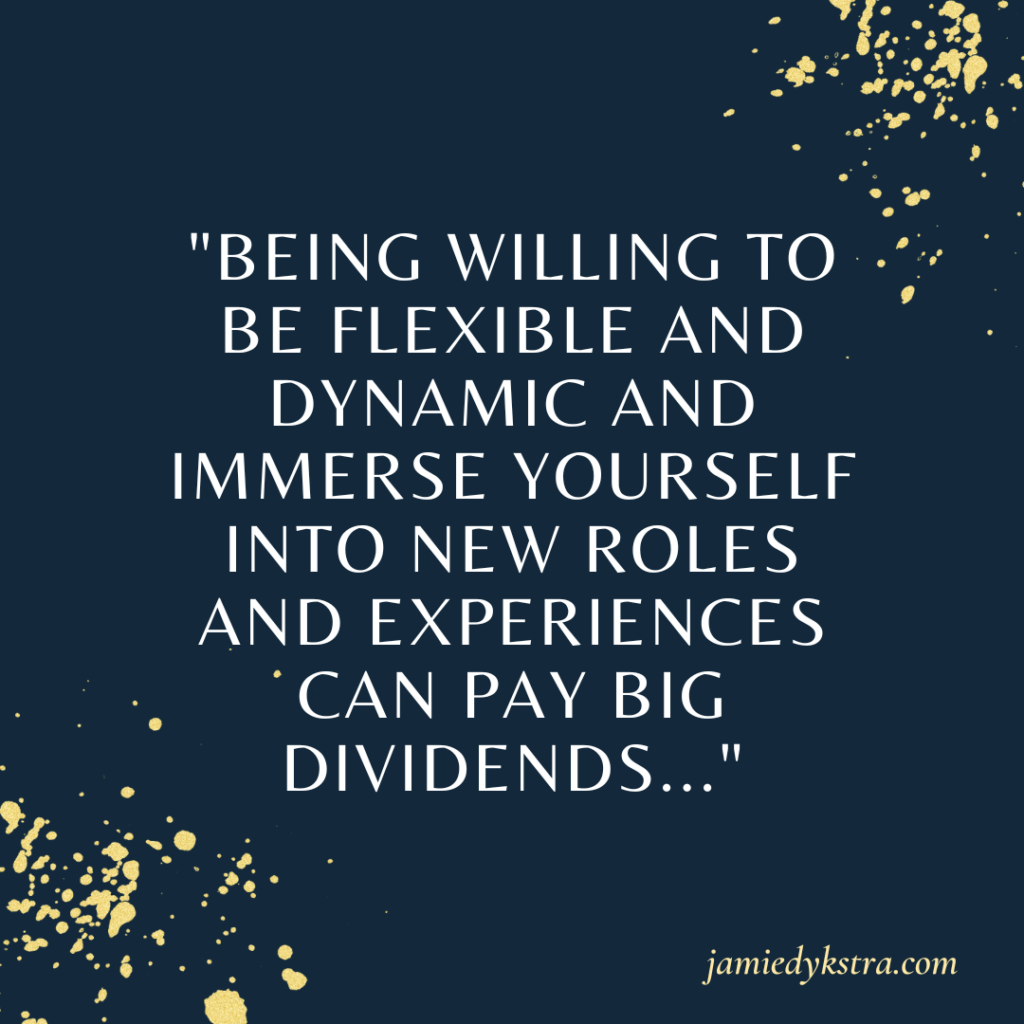
2) Being willing to be flexible and dynamic and immerse yourself into new roles and experiences can pay big dividends by granting you new experience, giving you new exposure, and potentially introducing you to a new path forward.
3) Sometimes others know what you need better than yourself. Gladys informed me some months later that she knew I wasn’t best suited for model development but that she knew that’s what I thought I wanted so she let me try it. I’m thankful that she recognized what my strengths were and where I would thrive and placed me there.
In the coming weeks, as I began to learn and grow into my new role, I had some crash course lessons in dealing with consultants, being active and taking leads in meetings, and moving into a new role within my team. While this time period was a bit of a whirlwind, I learned lessons that I still carry with me from these two simple conversations.
Have you found that some of the simplest conversations can also be some of your most impactful?
Disclaimer: This blog should not be construed as providing, or intending to provide, professional financial, legal, psychological, or other professional advice. It is simply meant to share my experiences for those that may find them relatable and helpful.