

Disclosure: I only recommend products/services I would use myself and feel might benefit you as well. This post contains affiliate links, and I may earn a commission at no extra cost to you. As an Amazon Associate I earn from qualifying purchases.
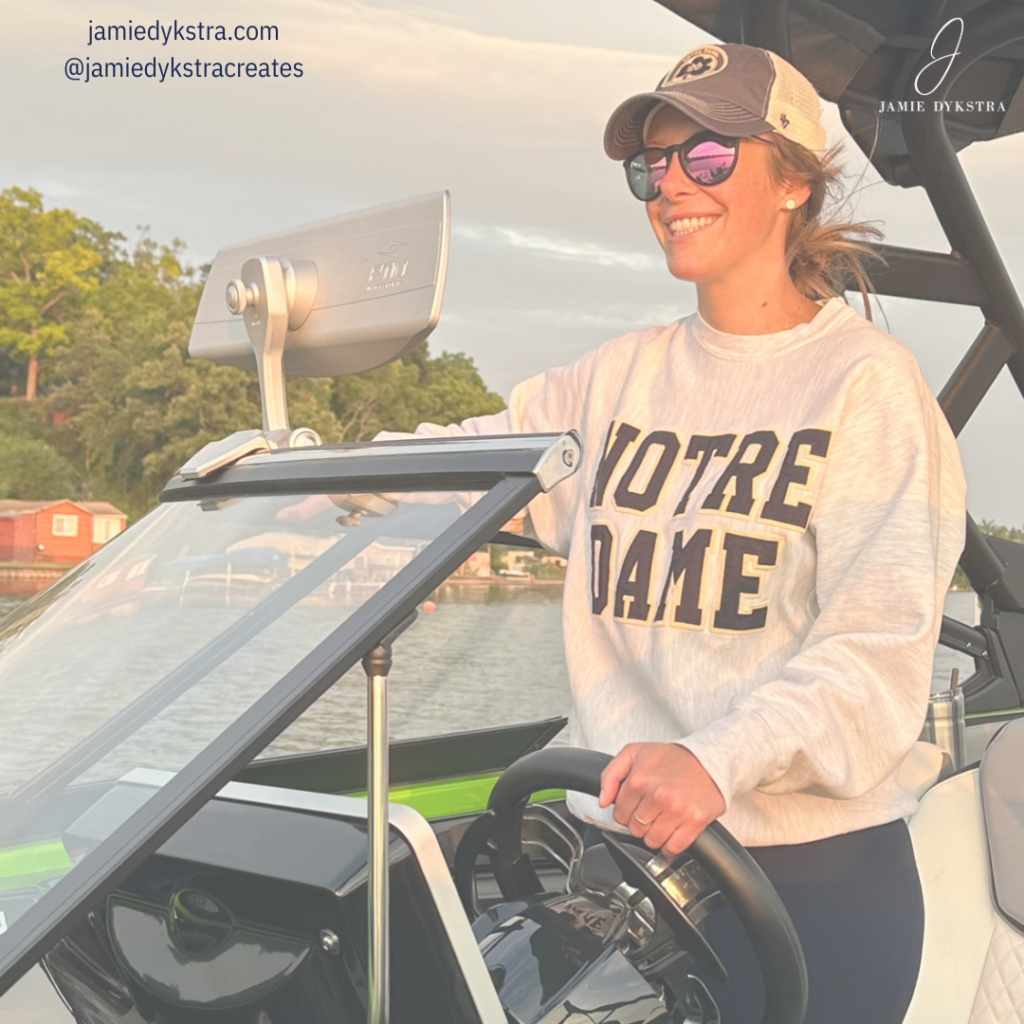
I sped across the lake with the wind whipping through my hair and the sun beating on my face, but it’s not all care-free and good vibes out on the water. Rather than immersing myself in the nature surrounding me, I remained hypervigilant for people, kayaks, logs, weeds, and anything else that may pop up in the water for both my own safety but also that of those around me. As I drove our watercraft and boat for this first time this season, it hit me that powersports are the perfect example of how the reticular activating system (RAS) works in the brain.
You might venture to compare this to driving a car where you are on the lookout for pedestrians, other drivers, and wildlife on the road. This is true; however, driving cars is a very structured activity with rules, infrastructure, and common knowledge that pretty much everyone has.
Step this analogy up to driving powersports where there is much less infrastructure and much more extreme terrain and circumstances, and you’ve got a whole new ballgame.
Being along for the ride
We’ll start this analogy off as a passenger on some sort of motorsport vehicle. Let’s use a snowmobile in our example.
Picture yourself on the back of a snowmobile, high in the Rocky Mountains, carving through the trails with an experienced driver at the handlebars. While you do need to focus on hanging on and leaning the proper directions, you pretty much get to sit back and take in the incredible views. You may be looking out over neighboring ski runs, eyeing the top of the peak, or trying to spot a moose in the distance.
Your brain is generally focused on the breathtaking environment that you are immersed in while somewhat naturally making sure you stay firmly on the back of the sled. As a passenger, you generally have a lot less that you need to keep top of mind when you’re with an experienced driver. For this reason, you can pretty much sit back and enjoy the ride.
The power and responsibility of being a driver
The game completely changes as a driver. No matter what sort of powersport unit you are driving, you have to be at the top of your game to ensure the safety of yourself and others. There is a constant need to be focused on the terrain and environment around you, be on the lookout for other drivers on the trails or the general vicinity, and be ready for a potential obstacle such as wildlife or debris. When getting onto a powersports unit, your mind switches into a whole different gear.
Let’s now picture ourselves driving the same snowmobile high in the Rocky Mountains. As the driver, you’re focused on the trail in front of you looking for ruts, changes in texture, or debris. You’re also looking ahead for oncoming traffic that you may be sharing the space with and anticipating their moves. On top of all of that, you’re monitoring each side of the trail as well for any potential wildlife that may jump in front of you. And finally, you’re watching the sleds in front of you and behind you to make sure your own group is having a safe ride.
Oh and you’re physically driving and navigating the sled through all of this… can’t forget that.
Much different vibe than the passenger on the sled, right?
As the driver of this snowmobile, you’ve told your brain to filter out all other distractions and focus on the items that you’ve trained it to look for in order for yourself and other riders to have a safe ride. Your brain is spending a majority of its energy on all of these items and is using any leftover energy to occasionally take in the views when the right opportunities arise.
This is a perfect example of the RAS. While I go about my daily life, of course I’m on the lookout for random obstacles I may encounter or animals I may see outside, but it’s not a primary focus of mine. My brain is probably spending its energy trying to focus on problem solving, planning, or engaging with others around me.
Hop into the driver’s seat of a powersports unit, and I’ve immediately turned the filter, or RAS, in my brain to focus on all of those items that are going to keep me and those around me safe, with minimal energy spent on other thoughts or distractions.
The driver of your own brain
While driving powersports is a huge responsibility, driving your brain to achieve your potential and purpose may be your life’s greatest responsibility. This is where the RAS can play a big part. So, what is the RAS?
The RAS is basically the filtering system of your brain. It’s what you tell your brain to focus on based on what is important to you. When you intentionally add a filter onto your RAS, you will start to notice relevant people, items, and events pop up all around you. This is why when you talk about something new or out of the ordinary, you suddenly start to notice it more often around you.
As Ed Mylett stated in a recent webinar, the brain is constantly looking to prove you right. It looks for evidence to prove you right so it no longer needs to spend energy on these thoughts. The brain likes to work towards what it’s most familiar with.
As Mylett also explains in his book The Power of One More (links to Hardcover and Kindle), this is why meditating, praying, journaling, or any sort of other reminder of your goals is so important. By consistently and intentionally putting these thoughts in your head, you are telling your brain to activate your RAS towards those goals. You will then start to notice all the people and opportunities around you that may help you reach that goal. Those people and opportunities were always there, but now your brain is tuned to be looking for them, and then voila! You’ve moved closer to your goals by intentionally activating your RAS.
So while it may sound simple, picture yourself as the driver on the crazy ride that is life, and flip your RAS on for all that is important to you; filter out the noise and focus on the priorities. This one basic first step will work wonders in helping you work towards your goals.
If this interests you, reach out to me using the button below to book your free discovery session to see if I can support you along your journey to unlock the full potential of joy, freedom, and strength within your life.
Disclosure: I only recommend products/services I would use myself and feel might benefit you as well. This post contains affiliate links, and I may earn a commission at no extra cost to you. As an Amazon Associate I earn from qualifying purchases.
Disclaimer: This blog should not be construed as providing, or intending to provide, professional financial, legal, psychological, or other professional advice. It is simply meant to share my experiences for those that may find them relatable and helpful.