Disclosure: I only recommend products/services I would use myself and feel might benefit you as well. This post contains affiliate links, and I may earn a commission at no extra cost to you. As an Amazon Associate I earn from qualifying purchases.
“This is totally helping with my decisiveness and overthinking,” I say to myself in the middle of my first high-demand project. Due to the pace of the project and the various demands to juggle, it was a necessity to be decisive and keep things moving. I thought this process would help me to improve my overthinking and lack of decisiveness habits, but it turns out that it was all just a cover up.
Less time to overthink in high demand environments
Every time I was part of a project or a process where the demands were high and the pace was fast, I felt the same way as I mentioned above. I’d think I was improving upon areas that I knew I needed to work on and that all this practice would finally make “perfect”.
Now that I’ve had time to reflect, I’ve come to the realization that high demand environments and situations helped me to cover up my overthinking. In those situations, I had less time to overthink and just had to trust my gut. Trusting my gut actually worked out really well for me and should have been a signal to me to do this more often.
However, rather than learning and growing from these experiences, I found myself reverting back to my old ways as soon as I returned to a more reasonable pace. I loved working in high stress and high demand environments. I used to think that it was just because I was wired to handle pressure well, which is also true. However, I’ve also come to realize that part of the reason I love these environments is because I’m forced to be decisive and trust my abilities to handle the situation appropriately.
These environments also deprived me of time to go back and rethink minor decisions I had made. There was no time and no point in going over the details of minor actions unnecessarily because the cost outweighed the benefit. I also felt like I had valid reason for my decisiveness and trust in myself.
Lack of time + high demands = justification for not being perfect
In addition to not having time to overthink and question myself, I also felt that I was justified in not being perfect when I was operating in a high stress and high demand environment. There were so many balls to juggle that I could not reasonably be expected to be perfect all the time. I felt that I would be more validated and given more grace if I had an instance where I was less than perfect when in the fast-paced, high demand environment.
In hindsight, this thought process was a bit ridiculous. No one has the expectation that everyone is perfect all the time, no matter what the environment is. I was just holding myself to different expectations than I was holding others. These expectations for myself were unrealistic.
No matter the environment, conscientious individuals will always act in the best way they know how in that moment. Learning and growth is part of the human experience and will yield improved results over time. It’s okay for this learning and growth to happen in all environments. Supportive colleagues, supervisors, friends, etc. will give you the grace to learn no matter the circumstance, not just when you feel you have a justification given the demands.
Increased validation through meeting high expectations
On the flip side of believing I received more grace in high demand situations, I also felt I received increased validation in these situations. I felt that, when demands and stress were high, the reward and recognition were higher.
When I performed well in a fast-paced, dynamic, demanding environment, I generally received greater praise and recognition for my efforts. This fire continued to fuel itself. I already began with a need for validation, the need was fulfilled with the recognition that I got for my performance that was above expectations, and then I sought out the next opportunity to feed this validation monster.
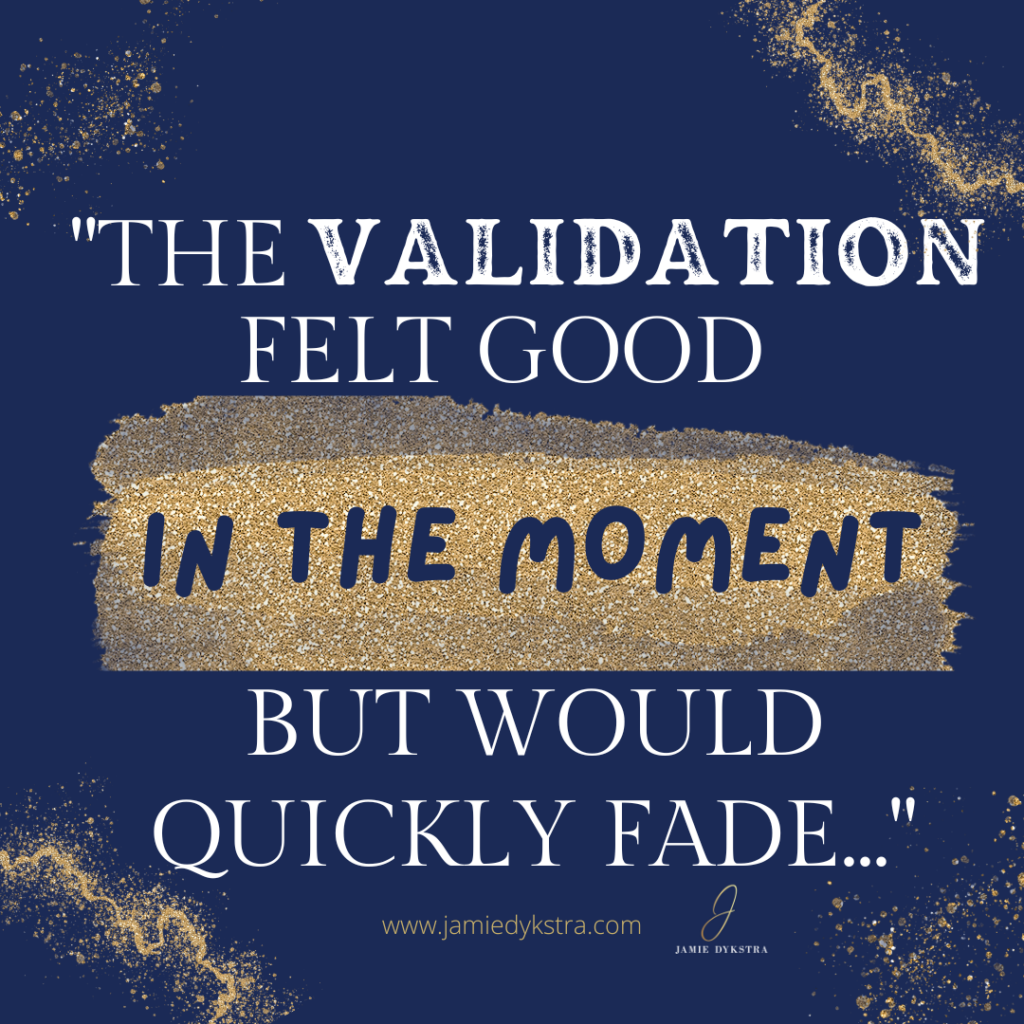
It’s a vicious cycle that I became obsessed with. I wanted to work hard, take on more stress, be on the next big project, and be accountable for the new responsibilities so that I could navigate choppier waters and receive the increased recognition. This validation felt good in the moment but would quickly fade as I looked towards the next challenge to get an even higher version of recognition.
What hindsight has taught me about my love of high stress environments
I’ve come to realize through coaching and self-reflection that I’ve primarily been gaining confidence from conditional validation, meaning from experiences such as getting voted captain of the team, winning that award, receiving that promotion, being recognized by an executive, and the list goes on and on. I didn’t really truly love the high stress environments; I loved the cover-up of the self-doubt that the high stress environments gave me.
While I normally wrap up with lessons learned from the experiences I shared, I won’t be providing that this week. Essentially, I’ve learned one holistic lesson that I was covering up areas that I needed to heal and wanted to improve upon by putting myself in situations that would feed me validation so I didn’t have to put in this effort myself.
This is an area that I’m still learning and growing into. It’s a process. However, I think this is an area that resonates with a lot of people and manifests itself in different ways depending on the background we come from.
If this theme speaks to you, I invite you to subscribe to my email list to learn more about my journey, extra materials I provide, and some weekly inspiration. Furthermore, if this inspires you to look deeper into what you love and why you love it, I invite you to check out Start with Why: How Great Leaders Inspire Everyone to Take Action by Simon Sinek. I believe it is relevant on both the individual level and for you to know your team better.
Disclosure: I only recommend products/services I would use myself and feel might benefit you as well. This post contains affiliate links, and I may earn a commission at no extra cost to you. As an Amazon Associate I earn from qualifying purchases.
Disclaimer: This blog should not be construed as providing, or intending to provide, professional financial, legal, psychological, or other professional advice. It is simply meant to share my experiences for those that may find them relatable and helpful.